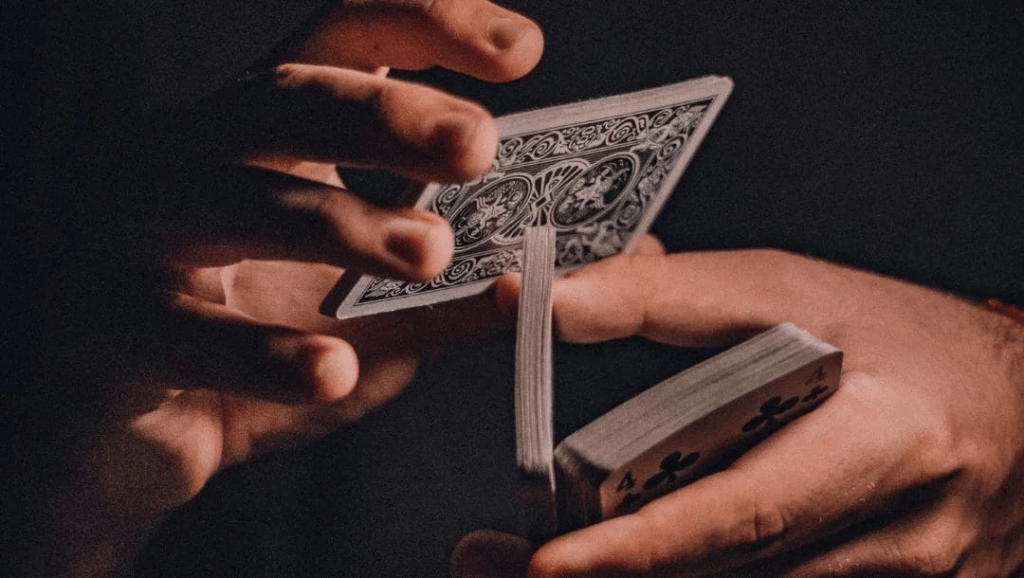
Card games have been enjoyed for centuries, offering Freecreditmalaysia99 fun and competition across cultures and generations. Whether it’s the bluffing of Poker, the strategy of Bridge, or the family fun of UNO, one thing is essential to the integrity of the game: the shuffle. A good shuffle ensures that the deck is randomized, giving each player an equal chance of winning, while also maintaining fairness and excitement. But have you ever wondered how shuffling actually works from a scientific perspective? In this article, we’ll explore the fascinating world of card shuffling, diving into the physics, mathematics, and probabilities behind the perfect shuffle.
- What is Shuffling?
At its core, shuffling is the process of mixing up the cards in a deck to ensure randomness. The objective is to eliminate any patterns or order in the cards, so that the sequence in which they are dealt is as unpredictable as possible.
The two most common types of card shuffling are:
Riffle shuffle: This is the traditional “interlacing” shuffle, where two halves of the deck are split and then interwoven together. It’s the shuffle you’ll often see in movies or competitive card games.
While both methods work to randomize the deck, the science behind how well they achieve this randomness is where things get interesting.
- The Mathematics of Shuffling: How Many Shuffles Are Enough?
A key question many people ask is: How many shuffles does it take to randomize a deck?
The answer lies in the concept of entropy, which refers to the degree of randomness or disorder in a system. In the context of a deck of cards, entropy describes how mixed up the cards are. To achieve a sufficiently random deck, you need to increase the entropy to the point where the order of the cards is effectively unpredictable.
According to a study by mathematician Persi Diaconis in the 1990s, the answer to this question is surprisingly specific: seven riffle shuffles are typically sufficient to make a deck of cards as random as possible. Diaconis and his colleagues used computer simulations to model the shuffling process and found that after seven shuffles, the deck has reached a level of randomness close to what we’d expect from a truly random sequence.
- The Physics of Shuffling: How Does the Deck Mix?
Card shuffling isn’t just about randomness—it’s also about physics. Every time you shuffle a deck, you’re applying force to the cards in different directions, causing them to interact in specific ways.
The riffle shuffle involves the cards bending and interleaving as they’re released from one hand to another. The cards will collide and slide against each other, creating friction and energy that helps to mix them.
The overhand shuffle relies more on gravity and the motion of your hands to pull cards from the top of the deck, causing them to cascade and land in new positions. While this method is quicker, it is less efficient than the riffle shuffle for creating true randomness.
Interestingly, studies have shown that even though both types of shuffling involve physical forces, they have different levels of efficacy. The riffle shuffle, particularly when performed multiple times, is far superior in terms of randomness because the cards are interwoven in ways that the overhand shuffle simply cannot replicate.
- Shuffling and Probability: Is It Truly Random?
While the goal of shuffling is to achieve randomness, it’s important to note that true randomness can never be fully achieved in a real-world setting due to physical constraints. That said, card shuffling can still get very close to randomness, which is enough for the purpose of fair play.
In terms of probability, shuffling creates a uniform distribution of the cards, meaning that each card has an equal chance of appearing in any given position. In theory, after enough shuffles, every card in the deck has an equal likelihood of being dealt in any order, ensuring that no one can predict or control the outcome of the game.
However, as we saw with Diaconis’ research, not all shuffling methods are equally effective at creating this uniform distribution. For example, a single riffle shuffle or just a few overhand shuffles will still leave some level of order in the deck, meaning that the probabilities are not yet evenly spread. In practical terms, this means that seven riffle shuffles are the sweet spot where the deck has enough randomness to eliminate any noticeable patterns.
- Shuffling and the Psychology of Players
The way cards are shuffled can also have a psychological effect on players. In competitive card games like Poker, players may use the shuffle as a means of psychological warfare—perhaps by attempting to convince their opponents that they’re not shuffling well, or by giving the impression of a “lucky” or “unlucky” shuffle.
- Shuffling and the Rise of Technology: Digital Shuffling
While physical shuffling is still the most common method in many card games, the advent of digital card games has introduced a whole new realm of shuffling. Online platforms like PokerStars and mobile apps for games like Hearthstone or Magic: The Gathering use computer algorithms to shuffle virtual decks.
These digital shuffles are designed to mimic the randomness of physical shuffling but are often based on pseudo-random number generators (PRNGs), which use mathematical formulas to produce sequences that appear random. While not truly random, PRNGs are typically sufficient for card games, offering results that are statistically indistinguishable from a well-shuffled physical deck.
- Why Shuffling is Important
In any card game, whether it’s a casual family gathering or a high-stakes tournament, shuffling is integral to fairness and unpredictability. A proper shuffle ensures that each player has an equal chance of winning, keeps the game exciting, and prevents anyone from gaining an unfair advantage by manipulating the deck.
Without a proper shuffle, games would become predictable, and players could potentially exploit knowledge of the deck’s order to their advantage, undermining the integrity of the game.
Conclusion
Card shuffling, far from being a simple task, is a complex process that involves mathematics, physics, and psychology. From understanding the number of shuffles needed to achieve randomness to recognizing the role of probability in card games, the science behind shuffling adds an interesting layer of depth to a beloved pastime. Whether you’re shuffling a deck by hand or relying on a computer algorithm, the goal is the same: to ensure fairness, excitement, and an equal chance for all players.
 Site Title